What Is Answer Engine Optimisation (AEO)? Sarac Ramsay Guide for AEO 2026
Understand what answer engine optimisation is, why it matters for your business right now, and how it differs from traditional SEO.
Published:
Last updated:
5 min read

Written by:
Matt Sarac

Speak directly with the partners
Talk to a specialist and find out exactly what your business needs to grow online
What is answer engine optimisation?
Answer engine optimisation (AEO) is the process of optimising your website and online presence to appear in AI-generated answers from tools like ChatGPT, Gemini, and Perplexity. The goal is to make it easy for AI engines to find, read, and cite your business when someone asks a relevant question.
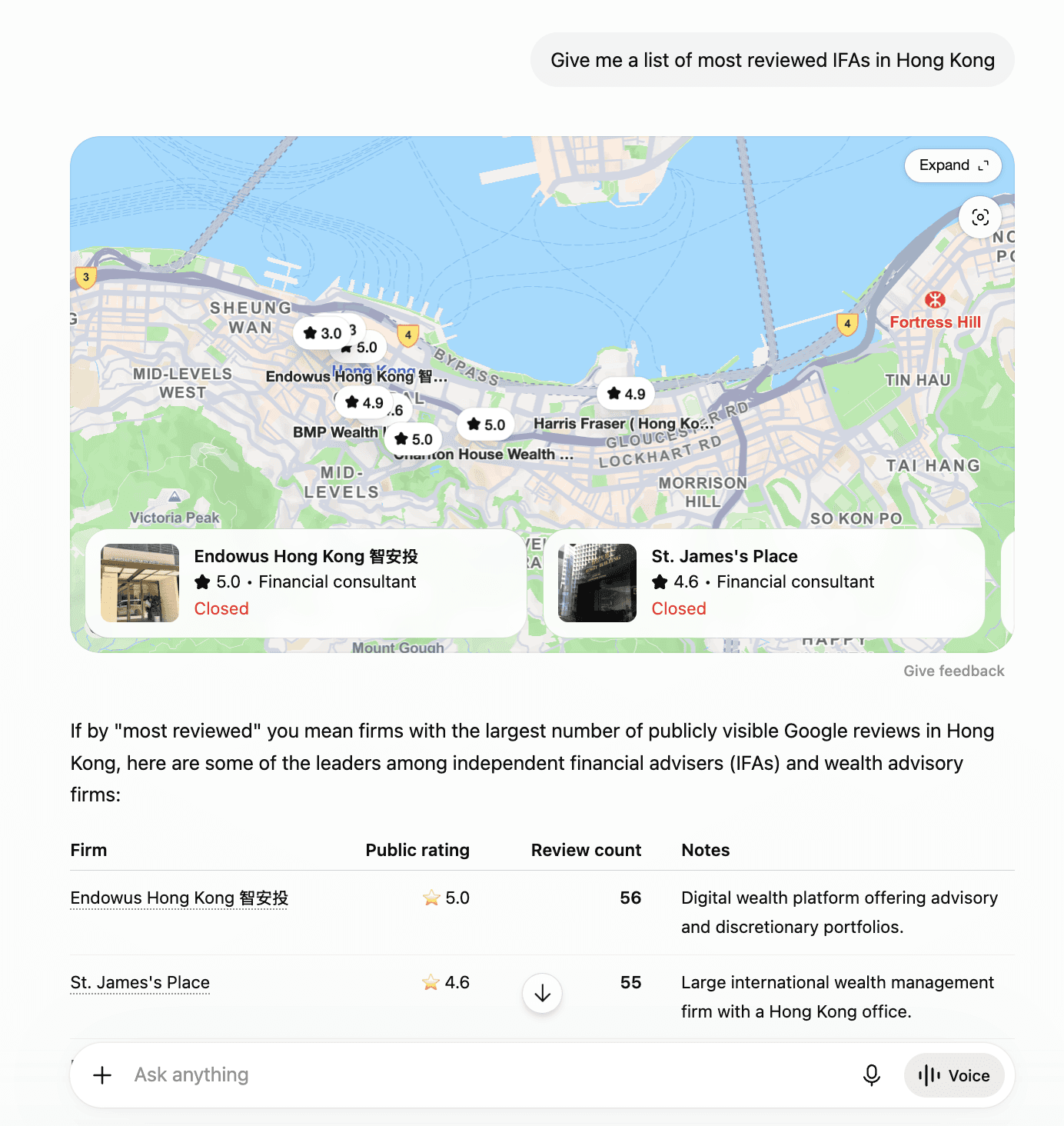
* ChatGPT now surfaces Google Maps results and review data directly inside its answers when someone searches for financial advisers in Hong Kong.
Why does AEO matter?
Search behaviour is changing faster than most businesses have noticed. People are avoiding traditional Google search and going directly to AI tools for recommendations, comparisons, and buying decisions.
You can see this shift in the numbers:
400 million+ people use OpenAI products every week
45% of consumers used ChatGPT to find a local business in January 2026, up from 6% a year earlier
25% of organic search traffic is predicted to shift to AI tools by the end of 2026
14.2% is the average conversion rate of AI-referred traffic, compared to 1.76% from Google organic
This does not mean traffic from Google is disappearing; rather, it is moving. The businesses that show up in AI answers are capturing high-intent visitors who have already been pre-qualified by the AI before they even click. The businesses that do not show up are losing customers they never knew were looking.
What is the difference between AEO and SEO?
AEO and SEO have the same goal — better visibility online — but they work on different platforms and use different signals to get there.
SEO | AEO | |
|---|---|---|
Platform | Google, Bing, DuckDuckGo | ChatGPT, Gemini, Perplexity, AI Overviews |
User behaviour | Short keyword searches | Full conversational questions |
Key signals | Backlinks, keywords, page speed | Authority, specificity, reviews, citations |
What you earn | A ranked position in search results | A named mention inside an AI answer |
Metrics | Rankings, impressions, traffic | Citations, mentions, referral traffic |
There is significant overlap between the 2. Websites that rank well on Google are more likely to get cited by AI engines. That is because:
73% of Bing search results appear in ChatGPT responses
61% of Google's first-page results appear in AI Overviews
That means strong SEO is the foundation for AEO, not a replacement for it. You need both.
How AEO actually works
AI engines generate answers by pulling from 2 sources:
Source | What it means |
|---|---|
Training data | Historical internet data the AI was trained on up to a specific cutoff date |
Live internet data | Real-time retrieval from a search index like Bing or Google when Search is enabled |
Not all AI engines use the same search index:
AI engine | Live data source |
|---|---|
ChatGPT | Bing |
Perplexity | Bing |
Microsoft Copilot | Bing |
Gemini | |
AI Overviews | |
Apple Intelligence |
This matters because if your site is not indexed on Bing, ChatGPT cannot find you regardless of how well you rank on Google. Most businesses have never submitted their sitemap to Bing Webmaster Tools. That is 1 of the most common and most fixable gaps in AEO.
AEO vs SEO: do you need both?
Yes. Here is a practical way to think about it.
SEO gets you in front of people who are actively searching. AEO gets you recommended to people who are asking. Both represent high-intent moments, and they are increasingly happening on different platforms.
The businesses winning right now are doing both well:
Strong on-page SEO signals support AEO by building the authority AI engines trust
AEO-optimised content performs better in traditional search because it is structured, specific, and well-cited
Businesses that build both now are creating a compounding advantage that is very hard to close later
Think of SEO as the foundation and AEO as the next floor. You build them in order, not in competition with each other.
AEO by industry: where the opportunity is biggest right now
Not every industry is equally affected by AI search. Some sectors are already seeing AI tools intercept the majority of their buyer research. Others are still in the early stages.
Industry | AIO trigger rate | Urgency |
|---|---|---|
Healthcare | 48.75% | Critical |
Finance | 25.79% | Critical |
Insurance | ~20% | Critical |
B2B Technology | ~22% | Critical |
Education | ~18% | High |
Travel and Hospitality | ~12% | High |
Retail and Ecommerce | ~8% | Growing |
Real Estate | 4.48% | Emerging but moving fast |
Insurance is a clear example of how fast this is moving. 1 of our clients, Lifestyle Insurance in Hong Kong, was ranking at position 65 for major health insurance keywords. After fixing their foundational SEO and AEO signals, they moved to position 15. The searches were already happening. The visibility was the problem
The most common AEO mistakes businesses make
Most businesses attempting AEO make the same set of avoidable errors. Here is what to watch for:
Treating AEO as a content volume game. AI engines do not cite more content, but better content. Publishing 50 generic and low value articles in a month will not move the needle as much as 3 specific, well-structured pieces covering the right topics will.
Ignoring Bing entirely. The majority of AEO efforts focus on Google because that is where traditional SEO lives. ChatGPT and Perplexity use Bing. If your site is not in Bing's index, you are invisible to the 2 most cited AI engines.
Hiding content behind JavaScript or accordions. AI crawlers read raw HTML. If your FAQ answers, service descriptions, or key claims are loaded dynamically or hidden behind click-to-expand elements, they do not exist for AI engines.
Publishing content with no citable claims. Vague general content gets read and ignored. AI engines cite pages that contain a specific stat, a named outcome, or a unique claim that cannot be found anywhere else. Every piece of content should include at least 1 of these.
Not collecting reviews. Reviews are a core AEO signal, not just a trust badge for website visitors. AI engines cross-reference your reputation across third-party sources before deciding whether to recommend you. Businesses with fewer than 50 Google reviews are rarely cited by name in AI answers.
Who needs AEO right now?
AEO is most urgent for businesses in the following situations:
You are in a high-consideration category where buyers research before purchasing, such as insurance, financial services, healthcare, legal, or real estate
Your customers are expats, international buyers, or digitally active demographics who use AI tools regularly
You are already investing in SEO and want to extend that investment into the channels where your customers are moving
You have noticed organic traffic declining but enquiries and revenue holding steady or growing
If you are not yet doing basic SEO, that comes first. AEO requires a solid SEO foundation to work. Once that foundation is in place, AEO is the logical next step.
Your AEO readiness score
Score yourself across these 8 signals. Each one is a yes or a no.
Signal | Yes | No |
|---|---|---|
Site is indexed and crawlable on Bing | 1 point | 0 points |
Key content is visible in raw HTML, not behind JavaScript | 1 point | 0 points |
FAQ sections are open and visible on the page, not accordion-hidden | 1 point | 0 points |
Schema markup is in place on key pages | 1 point | 0 points |
50+ Google reviews with a 4.3+ average | 1 point | 0 points |
At least 1 comparison or listicle article in your niche | 1 point | 0 points |
Named author with visible credentials on all published content | 1 point | 0 points |
AI visibility is tracked with a specialist tool | 1 point | 0 points |
Your score:
7 to 8 — Strong foundation. Focus on content quality and off-site citation building
5 to 6 — Solid base with clear gaps. Prioritise the missing signals before expanding content
3 to 4 — Several foundational issues to fix before content investment will compound
0 to 2 — Start with technical and GBP fixes before anything else. The foundation is not in place yet
How to get started with AEO
Getting started does not require a complete overhaul of your marketing strategy. Start with the most accessible fixes and build from there.
Submit your sitemap to Bing Webmaster Tools if you have not already
Check that your key content is in the raw HTML of your pages, not hidden behind JavaScript
Add a visible FAQ section to your most important pages with direct, factual answers
Add schema markup to your service pages, blog posts, and FAQ sections
Collect reviews actively on Google, Trustpilot, and any industry-relevant platforms
Write 1 comparison or listicle article in your niche that is specific enough to be cited
Track your AI visibility using a tool like Peec AI or Profound so you can measure what is working
Is AEO the same as GEO?
Not exactly. GEO (Generative Engine Optimisation) is a broader term covering all generative AI outputs. AEO focuses specifically on answer engines like ChatGPT and Gemini. In practice, the tactics overlap significantly.
Does AEO replace SEO?
No. SEO and AEO work together. Websites with strong SEO signals are more likely to get cited by AI engines. AEO adds a layer of optimisation on top of an existing SEO foundation.
How long does AEO take to show results?
Technical fixes can show impact within a few weeks. Building real citation authority typically takes 3 to 6 months of consistent effort.
Is AEO worth it for small businesses?
Yes, and particularly for small businesses in competitive niches. AI engines regularly cite small, specific, credible sources over large generic ones. A small insurance broker with well-structured, specific content can outrank a national brand with a thin website in AI answers.
How do I know if AEO is working?
Standard analytics tools do not capture AI citation data. You need a specialist platform like Peec AI, Profound, or Otterly to track citation rates across ChatGPT, Gemini, and Perplexity. Without measurement, you are optimising blind.
Matt Sarac
Matt Sarac is co-founder of Sarac Ramsay, a growth consultancy specialising in SEO, AEO, and paid advertising for expat service companies across 189 countries. He has worked directly with insurance brokers, financial consultancies, and real estate firms across 10 industries, generating over €310,000 in new client revenue in the last 90 days.

